Your guide to Heidelberg Gauteng

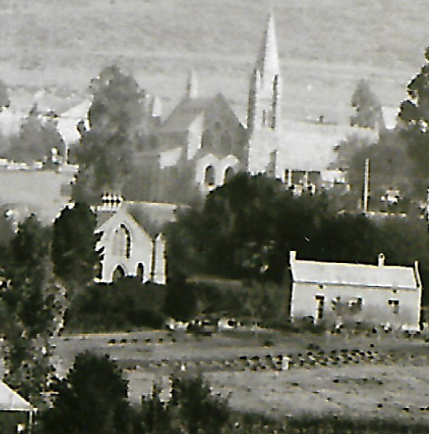
#Heidelberg Methodist Church
Heritage Blue Plaque #Nr 26
HEIDELBERG METHODIST CHURCH - Corner Strydom and Ueckermann Streets

What is the story here?
When Heidelberg was proclaimed as a town in 1866, there were no English churches. The English speaking community had to have their children baptised by Rev Van Warmelo of the Heidelberg Hervormde Church. The first services of the Wesleyan Methodist Church were conducted by Rev George Weavind as far back as 1875. The coach house which was opposite the Heidelberg Club (Where the KFC is today) was the first building used by the Methodist community as a church from about 1890.The ground for the present church was purchased in 1895. Interesting that the church was built on the original road from Durban and when the town roads were set out, the ox-wagons would cut across the corner of the property.
THE HISTORY OF THE HEIDELBERG METHODIST CHURCH
ARCHITECTURAL ORIGINS AND STRUCTURAL EXPANSIONS (1895 - 1902)
The primary sanctuary of the Methodist Church on Strydom Street was constructed in 1895, originally built as a straight hall without its current T-section layout. In 1897, the local English community of Heidelberg commissioned and donated two custom stained-glass windows to the town's English-speaking parishes: one to the Anglican Church and the other to the Methodist Church.
The Methodist window was initially positioned on the Ueckermann Street elevation before being structurally relocated to its contemporary position within the sanctuary. The window glass still retains visible scars and cracks caused by stones thrown at the building during the Second Anglo-Boer War. Early interior photographs of historical Harvest Festival displays reveal that the church boasted an elaborate set of traditional pipe organs to support a robust 17-member parish choir.
Following the conclusion of the war in 1902, the district experienced a massive influx of labourers who arrived to work on the 14 active gold mines surrounding Heidelberg. During this boom era, local Presbyterians lacked a dedicated sanctuary of their own and shared the Strydom Street building for their weekly worship.
To safely accommodate the combined, expanding congregations, the church elders resolved to construct a permanent T-section expansion onto the original building. To clear the necessary ground, the church purchased the adjacent plot from the local chemist, Mr Walter Harvey, for a sum of £400.
As the regional mining economy eventually declined, the temporary population drifted away from Heidelberg. The local Presbyterians migrated to their own newly constructed stone church in 1905, leaving the Methodists with excess space.
The elders subsequently installed a large wooden partition wall to split the sanctuary, creating a separate community hall in the rear section of the building. Local parishioner Cherry Ross preserved childhood memories of this structural barrier, which was permanently dismantled in later decades as the core Methodist congregation grew to fill the entire space.
THE STOLEN SAFE AND REUTER'S CORRESPONDENT HARRY WEAKLEY
The institutional history of the parish suffered an irreversible catastrophe in 2000 during the pastoral tenure of the Reverend Don Williams. Thieves infiltrated the church precinct and stole the main iron safe, which permanently held the original 19th-century baptismal and funeral registers, the foundational property title deeds, and the early written history of the church.
During the subsequent investigation, a slide projector that had been stored inside the stolen safe was recovered from a rubbish bin outside the old Spur Restaurant, which previously operated upstairs on the corner of Voortrekker and Jacob Streets. Reverend Williams systematically searched every alleyway, footpath, and riverbank in the district in gumboots and water leggings, but the safe and its priceless historical documents were never found.
To secure the vulnerable precinct against future intrusions, an alarm system was installed, security gates were mounted to the side doors, and parishioner Ernest Boy engineered a heavy iron security bar system on the inside of the main front doors. The survival of the parish's timeline is credited entirely to Jeanette Westman, who meticulously compiled two independent archival research files to reconstruct the history of the Methodist Church from external sources.
The church's early 20th-century history was anchored by the layman Harry Weakley (1863 - 1943). Weakley served the congregation as a lay preacher and dedicated Sunday School Superintendent for 49 consecutive years, routinely travelling his extensive preaching circuit via bicycle before later upgrading to a traditional horse and trap. Outside of his church ministry, he was a talented landscape artist and the owner-editor of the Heidelberg Times newspaper, residing at Kenton Villa on Fenter Street until his death in 1943.
CHRONOLOGICAL DIRECTORY OF MINISTERS (1890 - 2021)
-
Reverend W.B. Milward (1890 - 1893)
-
Reverend J.F. Rumfitt (1893)
-
Reverend C.F. Woofenden (1894 - 1896)
-
Reverend R. Appleby (1897 - 1899)
-
Reverend E.H. Morgan (1899 - 1902)
-
Reverend W.C. Burgess (1901) - Served concurrently as an official British military war chaplain during the occupation.
-
Reverend E. Titcomb (1902 - 1904)
-
Reverend Edward Dunstan (1904 - 1909)
-
Reverend P. Spencer (1909 - 1913)
-
Reverend G.H. Eva (1913 - 1917)
-
Reverend R.J. Good (1917 - 1923)
-
Reverend A. Cowgill (1923 - 1924)
-
Reverend C.D. Choate (1925 - 1926)
-
Reverend G. Moseley (1926)
-
Reverend M.M. Cobban (1926 - 1931)
-
Reverend J.A. Gurney (1932 - 1933)
-
Reverend R.I. Thompson (1933 - 1934) - Affectionately known to the parish as Ronnie. Archival vestry photographs show him wearing a piped sports jacket and white trousers with prominent turnip cuffs, reflecting the popular men's fashion trends of the era. He remained unmarried during his local tenure.
-
Reverend R.J. Moore (1934 - 1939) - A highly respected minister whose archival records include a 1941 portrait taken while he attended an official military officers' training course at Roberts Heights (subsequently renamed Voortrekkerhoogte, now Thaba Tshwane). A 1942 family photograph was mass-reproduced to serve as a community postcard. Vestry records confirm that the adjacent Cory family maintained a private gate in their boundary wall to walk directly from their home into the church grounds.
-
Reverend T. Crabtree (1935)
-
Reverend L.J. Ray (1939)
-
Reverend E.H. Proctor (1940 - 1942)
-
Reverend A. Matthews (1943)
-
Reverend J. Jackson-Smith (1944 - 1953)
-
Reverend J. Gibson (1954 - 1958) - A quiet, reserved, and deeply respected theologian who suffered from degenerative eyesight and went entirely blind in his later years. He dedicated his retirement to assisting the Association for the Blind, navigating the town with his certified guide dog.
-
Reverend P. Woolston (1959)
-
Reverend J.M. Carruth (1960 - 1966) - Originally arrived in South Africa serving as a Salvation Army Chaplain. He remained a bachelor and resided inside Wesley House, routinely visiting rural parish families on their farms. Although he owned a motor vehicle, he could not drive and relied on a designated parish driver for his pastoral trips. Following his death, his sister donated the church's two main front entrance doors, which were formally installed in his memory on 5 November 1968.
-
Reverend B. Bird (1967 - 1970)
-
Reverend I. Lindsay (1971 - 1972)
-
Reverend Gavin Taylor (1973 - 1976) - Arrived in Heidelberg to complete his critical first year as a probationer minister. His family endured an early domestic crisis when their 18-month-old son, Matthew, wandered into the manse garage and accidentally ingested turpentine. The infant was rushed to the local hospital, where doctors pumped his stomach and kept him inside an oxygen tent for several days. Reverend Taylor also served as a part-time chaplain for the nearby Heidelberg Army Gymnasium, and his two daughters were born during his local tenure.
-
Reverend M. Black (1977 - 1980)
-
Reverend Ross A.J. Olivier (1981 - 1988) - The final resident minister to occupy the historic Wesley House, as the close proximity to the active church grounds left the family with no private domestic life. Alternative housing was eventually secured. His ministry was defined by a notable encounter when a severely intoxicated man entered the sanctuary and interrupted a Sunday service. Reverend Olivier intervened gently, calmed the individual down, and seamlessly continued his sermon. Under Olivier's long-term pastoral care, the man completely rehabilitated his life. The man was a single English immigrant with no living relatives in South Africa who worked on the local mines; upon his death, he bequeathed his entire private estate and vehicle to the Heidelberg Methodist Church. The church utilized this inheritance to purchase the contemporary church manse located in Mona Drive.
-
Reverend A.O’B. Sutton (1988 - 1994) - The first resident minister to take up occupancy inside the newly acquired Mona Drive manse.
-
Reverend Dawn Slabber (1994 - 1996) - Achieved historical prominence as the very first female minister appointed to lead the Heidelberg Methodist congregation.
-
Reverend Aubrey Clark (1997 - 1999) - Transferred to the parish following a long ministry in Beaufort West.
-
Reverend Don Williams (1999 - 2001) - Managed the parish through a succession of three major burglaries and directed the post-theft security upgrades.
-
Reverend Diane Moodie (2001 - 2005) - Born in Texas while her father, a South African Methodist minister, was studying abroad. Her family returned to South Africa when she was two, but immigrated back to the United States during the political instability of the 1970s. After earning a Master of Divinity degree, she returned to visit South Africa in 1999, felt a deep spiritual connection, and chose to remain permanently. She met her husband, Brian (the minister of the Duduza Methodist Church), in Soweto and was formally ordained in October 2002. A skilled musician, she frequently played her flute during services and learned to play the guitar during her Heidelberg tenure.
-
Reverend Ray Goddess (2006 - 2017) - Born in Vereeniging in 1952, he and his wife, Elize, were married by the minister of the Benoni Central Methodist Church and became deeply involved in lay ministry. After both received a full spiritual calling, they completed a standard three-year theological diploma course in just two years, entering full-time ministry training in Uitenhage in 2005. Sourced by the Bishop of the Highveld and Swaziland district, they accepted a joint appointment to minister to the Nigel and Heidelberg parishes, completing a five-year probation before being ordained in 2009. They made history as the first married couple within the Methodist Church of Southern Africa to enter the ministry and achieve ordination together in the same year. Reverend Ray initiated numerous structural and community projects, including:
-
Converting the historic Wesley House into a modern community hall named Wesley Hall, officially opened by Bishop Brian Jennings.
-
Managing large-scale Christmas charity food hamper distributions throughout Extension 23.
-
Partnering with a coalition of local Heidelberg churches to successfully invite evangelist Angus Buchan to host a regional "Mighty Family" Christian event.
-
Relocating the administrative church office from the front of Wesley House into the Sunday School room, which previously functioned as the property garage.
-
Repainting the entire historic church exterior with a completely modernized colour scheme.
-
Constructing a secure new front and side palisade perimeter wall.
-
Installing an immersive baptismal bath and a new elevated stage inside the sanctuary.
-
Orchestrating a unique nativity pageant that featured a live camel on the church grounds.
-
-
Reverend Elize Goddess (2018 - 2020) - Assumed full pastoral leadership of the Heidelberg Methodist Church immediately following the retirement of her husband, Ray.
-
Reverend Michael Labaschagne (2021 - Present) - Appointed to guide the congregation into its contemporary era of local ministry.
Sources: The Methodist Church Historical Files meticulously compiled by Jeanette Westman, parish vestry records, and the oral history collection of the Heidelberg Heritage Association.