Your guide to Heidelberg Gauteng

#THE STORY OF HEIDELBERG
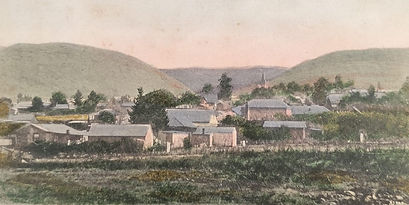
Heidelberg is a small town steeped in history and rich in architectural heritage. Established in 1866, this charming destination features well-preserved historical buildings that tell the story of its colonial past. The area was formerly known as the kraal of the Bakena until the onset of colonization and the Basotho wars.
Modern Heidelberg was established in 1862 as a trading post by a German named Heinrich Julius Ueckermann. A town was developed around his store and named after his alma mater. In 1866, the District of Heidelberg was formed from the eastern section of the Potchefstroom district, complete with its own landdrost (magistrate), having been designated as a church site in 1865.
Heidelberg has played a significant role in South African history, serving as the capital of the Boer republic during the conflict with Great Britain from 1880 to 1883 under the leadership of the Triumvirate of Paul Kruger, P.J. Joubert and M.W. Pretorius. The discovery of the Witwatersrand reef in 1885 led to the establishment of the Mining Commissioner's office here. Heidelberg evolved into a quintessential rural Victorian town, featuring many notable buildings.
Welcome to our exploration of Heidelberg's rich history. After extensive research and invaluable support from the Heidelberg Heritage Association, we're excited to share our findings with you. We hope you find as much joy in uncovering the stories of Heidelberg as we do. A heartfelt thank you to everyone dedicated to preserving and sharing this precious heritage!
#History of Heidelberg
A comprehensive overview of the foundational history of Heidelberg, Transvaal. From its roots as a critical highveld transport crossroads to its transformation into a prominent republican capital, this index tracks the early pioneer exploration, wartime strategies, and administrative milestones that sculpted the town from 1836 onward.

#Heidelberg Once a War Zone
An immersive chronicle documenting Heidelberg's strategic role as a highly contested command sector during the First and Second Anglo-Boer Wars. This chapter maps the dramatic field insurgencies, the operational movements of the local Heidelberg Commando, and the severe local impacts of the British martial law occupation and scorched-earth policies.

#Heidelberg Brothers Bomb Train
The thrilling military history of a daring guerrilla sabotage operation executed just four kilometres north of the Heidelberg station. Discover how Field Cornet Hans Botha successfully mined the strategic railway bridge spanning the Blesbok River on 30 June 1900, and the dramatic, unexpected blast reprisal that followed.

#Alice Glockner Nature Reserve
A detailed natural and conservation overview of the Alice Glockner Nature Reserve, founded in 1973. Discover the pristine highveld grassland biome that serves as a critical defensive stronghold for the highly endangered Heidelberg Copper Butterfly, its complex symbiotic ant partnerships, and its historic 19th-century gold prospecting ruins.

#The Spookbrug
The hydrological and environmental history of the Blesbokspruit river system. Sourcing its headwaters north of Daveyton, this vital corridor feeds the internationally protected Marievale Bird Sanctuary (Ramsar Site No. 343). This chapter highlights mid-century mine water contamination and crucial seasonal flash-flooding safety warnings.

#Heidelberg Heritage Association
The foundational registry and civic charter of the Heidelberg Heritage Association. Directed by local historians and preservationists, this chapter highlights the association's grass-roots community projects, the ongoing installation of blue heritage plaques, and the documentation of regional architecture.

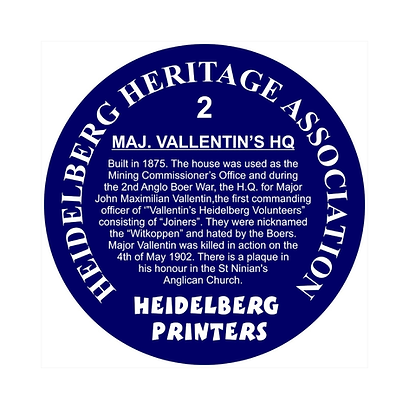
#Maj. Vallentin's HQ
The military history of the strategic garrison headquarters utilized by Brevet Major John Maximilian Vallentin during the Second Anglo-Boer War. Discover the administrative operations of Vallentin’s Heidelberg Volunteers, and the subsequent battlefield death of the commander at Onverwacht in 1902.
#The Goodwin Residence
The pioneering domestic history of No. 1 Van der Westhuizen Street, the grand 1881 estate established by the prominent Goodwin family. This profile tracks the family's migration from the Cape Colony, their extensive land holdings, and the subsequent mid-century subdivisions executed across the block.

#Laer Volkskool
The foundational chronicle of the historic Laer Volkskool campus, established on Opvoedingsbult in 1907. Discover how the ultra-wealthy Bezuidenhout brothers and Cornelis Meyer fully funded this pioneer Christian-National institution to secure the mother-tongue education of Heidelberg's children.


#Excelsior Hostel
The history of the original Excelsior Hostel, established in 1911 by dedicated schoolteacher Mr D.J.M. Jordaan. Discover how a row of four private houses along the Vereeniging Road was systematically leased to provide immediate, critical student boarding housing during an acute local accommodation shortage.

#Nederduitsche Hervormde Church
The theological and historical registry of the traditional Nederduitsch Hervormde (NH) Church in Heidelberg. This text explores the early frontier pulpits, the passionate resistance led by local elders against the 1885 church unification, and the subsequent legal battles over property rights.

#The Club House
The elite social history of the exclusive Heidelberg Club, founded in 1892 as the oldest private social club in the district. This profile documents its late Victorian architecture, its role as a premier gathering space for wealthy mining magnets, and the prominent portraits that hung in its main hall.


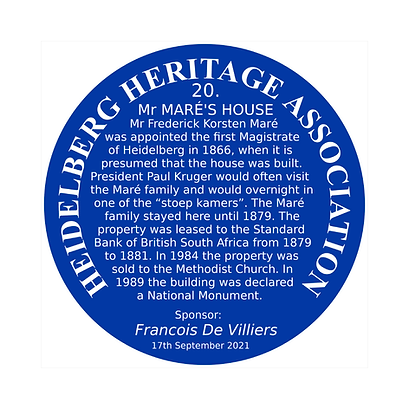
#Mr Maré's House
The domestic history of the elegant Pavilion-style residence built at Number 60 Strydom Street for the town's first Chief Magistrate, Frederik Korsten Maré. This profile details his administrative career, his refusal to take the British oath of allegiance, and his close friendship with Paul Kruger.
#Von Geusau House
The history of the grand 1880 family estate established by Attorney Adriaan von Geusau, a descendant of a German Baronial family who served as Mayor of Heidelberg. This profile details his legal practice during the war, and the Bonsma family's meticulous 1995 garden restoration project.

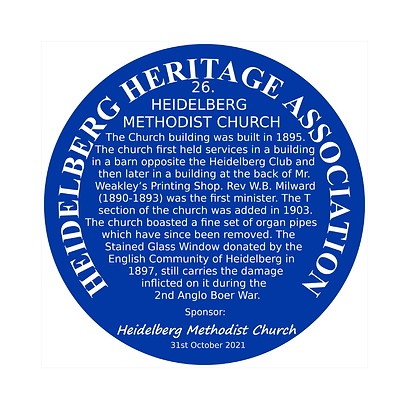
#Heidelberg Methodist Church
The architectural and spiritual timeline of the Methodist Church on Strydom Street, built in 1895. This chapter highlights its war-scarred stained-glass windows, its mid-century T-section expansion, and the catastrophic theft of the church safe and historic registers in 2000.

#General Piet Viljoen's House
The historic homestead profile of General Piet Retief Viljoen, the strategic commander of the Heidelberg Commando who negotiated the town's surrender to save it from British shelling in June 1900. This text details his post-war tenure as Mining Commissioner, and his family's struggles.

#40 HF Verwoerd St
The historical narrative of 40 HF Verwoerd Street, the pioneer estate originally owned by George Kinnear Blyth, a wealthy accountant and founding member of the Heidelberg Club. This text documents the property's modern transition into corporate offices and its 2021 Blue Plaque presentation.

#Grandpa Carl Schultz House
The history of the massive Burgererf estate established at 98 Begeman Street by German immigrant Carl Wilhelm Friedrich Schultz in 1890. This profile documents the early stables and orchards, the multi-generational family reunions around the study fireplace, and its modern subdivision into six houses.

#26 Fenter Street
The domestic and land lineage of 26 Fenter Street, inherited by Annie Hazel Matthysen (née Gemmell). This meta text documents the structural preservation of the home, its inter-war architectural layout, and its connection to Alexander Gemmell's historical plumbing firm on Jacobs Street.

#Police Barracks
The military and law enforcement history of the Overkruin Police Base complex. Originally established in 1900 as the centralized paramilitary camp for Major-General Baden-Powell's South African Constabulary (S.A.C.), this profile tracks its subsequent use as a hospital, mortuary, and television filming set.

#Harvey's Chemist
The commercial history of Harvey’s Pharmacy on Ueckermann Street, operating directly adjacent to the Old Standard Bank. This profile honors the civic legacy of pharmacist Walter Harvey, who served as Mayor of Heidelberg in 1923 and personally laid the foundation stone for the Old Landbank.

#Maternity Hospital
The institutional history of Heidelberg's early maternity healthcare facilities and nursing clinics. This text documents the mid-20th-century healthcare infrastructure of the town, tracking the dedicated mid-wives, maternal care advancements, and the operational links to the senior medical corps.


#Old Standard Bank
The financial history of the Old Standard Bank building on Strydom Street. This profile tracks the 1879 wartime lease signed by Magistrate Maré, the secret burial of £10,700 in gold sovereigns inside McLaren's garden in 1881, and the post-war audits surrounding the legendary "Kruger Millions."

#Settler House
A detailed architectural look at Heidelberg's authentic 19th-century settler town houses. This profile documents the traditional Grahamstown-style pitched roofs, the early river-reed thatch construction, and the traditional lime and sand exterior wall plasters utilized by early highveld masons.
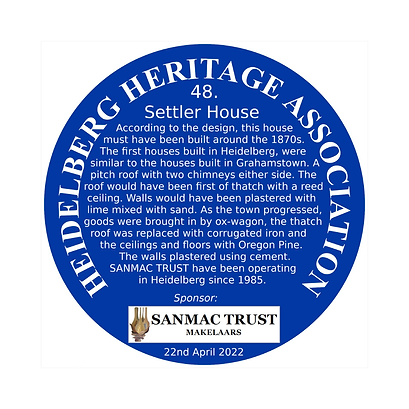

#Magistrate Maré's House
The property narrative of 85 Pretorius Street, tracing its title deeds back to early gold fields claim allocations. This profile documents its subsequent architectural evolution, its mid-century structural expansions, and the private families who looked after the home's historic highveld character.
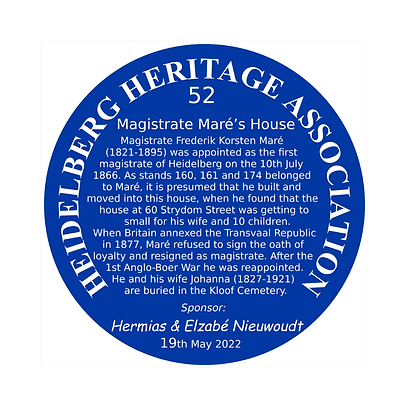

#Die Wyestoep Huis
The architectural profile of "Die Wye Stoep Huis" at 73 Pretorius Street, awarded Blue Plaque Number 56. This text highlights its 1890 rough-dressed sandstone foundations, its expansive wrap-around veranda addition completed in the 1920s, and its late 19th-century gold mining zoning ties.

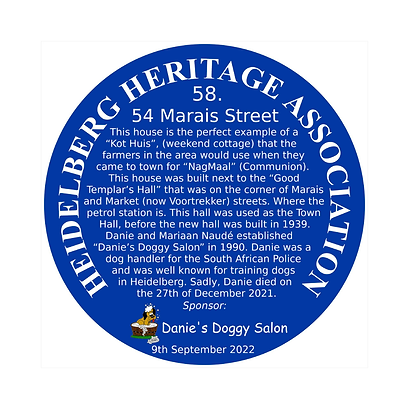
#42 Begeman Street
The property history of 42 Begeman Street, tracing its foundational title back to Dr Jeremias Ziervogel and the prominent Bronkhorst family. This profile documents the battlefield sacrifices of the Bronkhorst brothers in 1900, and the property's modern use as the Diamante en Goud jewelry shop.

#Jewish Synagogue
The cultural history of the Heidelberg Synagogue Hall at 42 Fenter Street, built in circa 1930 on land presented by merchant A. Abrahamson. This text documents early Jewish services dating back to 1893, its later mid-century nickname "Die Blou Kerkie", and its modern use as a community dance hall.


#1928 House
The architectural narrative of the historic 1928 Dutch Gable townhouse. This text documents its classic pressed-metal ceilings, its original Oregon pine floors and doors, and its late 20th-century residential use by the Kruger family, whose patriarch worked at the Rembrandt Cigarette Factory.

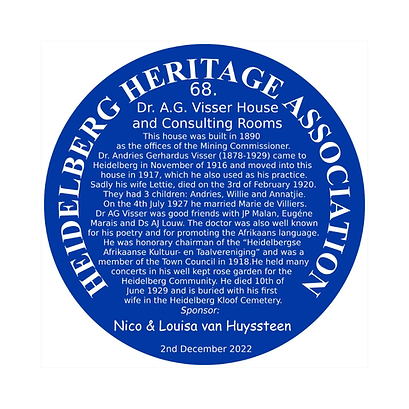
#Dr AG Visser House and Consulting Rooms
The supreme history of the A.G. Visser House, built in 1890 for the ZAR Mining Commissioner and later serving as the home of the iconic doctor and Hertzog Prize-winning poet Dr A.G. Visser. This extensive text details his political arrest in 1901, his medical training in Edinburgh, and its modern restoration.
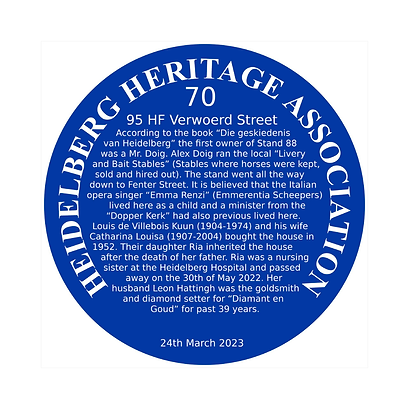
#95 HF Verwoerd Street
The historical narrative of 95 HF Verwoerd Street, built in the 1920s over the site of Alex Doig's historic livery and bait stables. This chapter highlights the home's connection to the childhood of international Italian opera soprano Emma Renzi, and its later ownership by Police Goldsmith Leon Hattingh.
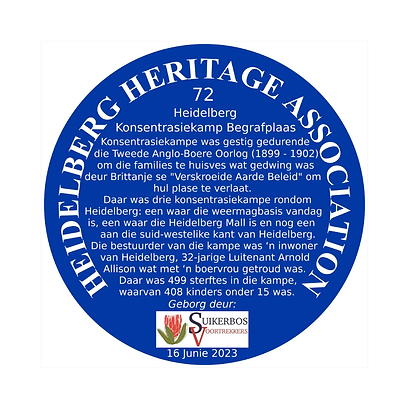
#Heidelberg Konsentrasie Kamp
The somber history of the main Heidelberg Concentration Camp precinct, established in 1900 under the British scorched-earth policy. This chapter documents the harsh camp conditions, the 500 civilian deaths, the 1901 camp school housed in the church, and the sympathetic command of local resident Lieutenant Arnold Allison.
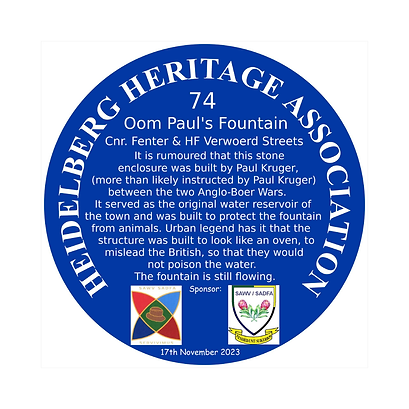
#Oom Paul's Fountain
The strategic history of "Die Bakoond" (The Baking Oven), an arched stone structural vault constructed directly over a natural freshwater spring. This text explores the Boer war strategy to hide the town's water from British troops, its 1970s collapse, and its modern restoration by the SAWV Suikerbos Unit.
#Ou Skom Cemetery
The history of the segregated burial grounds associated with the Old Location or "Ou Skom." This text captures the profound community customs of the location, where handmade coffins were reverently carried by hand to the graveside while passing citizens halted and bowed their heads in silent tribute.

#Heinrich Julius Ueckermann
The definitive biography of Heinrich Julius Frederick Ueckermann, the visionary German-born pioneer who founded Heidelberg in 1866. Track his perilous overland expeditions from Pietermaritzburg, the establishment of his original crossroads trading store on the farm Langlaagte, and his tireless multi-decade civic leadership in the ZAR Volksraad.

#Early Heidelberg
A captivating glimpse into daily frontier life when the young settlement of Heidelberg was still deeply embedded within the highveld wilderness. Discover a landscape where wild lions roamed the hills, blesbok and ostriches grazed along the riverbanks, and early pioneer families relied on traveling blacksmiths, traders, and preachers.
#Suikerbosrand Nature Reserve
Uncover the expansive pre-colonial and colonial history of the Suikerbosrand ridge. This chapter tracks the groundbreaking LiDAR discovery of a massive 15th-century Sotho-Tswana stone city, the 19th-century living exhibits at the functional Diepkloof Farm Museum, and the remnants of the imperial British guerrilla blockhouse network.

#The Blesbokspruit
The hydrological and environmental history of the Blesbokspruit river system. Sourcing its headwaters north of Daveyton, this vital corridor feeds the internationally protected Marievale Bird Sanctuary (Ramsar Site No. 343). This chapter highlights mid-century mine water contamination and crucial seasonal flash-flooding safety warnings.

#Heidelberg Heritage Museum
The historical profile of the old NZASM Railway Station precinct, opened in October 1896. This chapter charts its master sandstone architecture, its requisition as a major wartime transportation hub, its conversion into the Rembrandt Transport Museum, and the contemporary factors leading to its regrettable closure.

#Old Gaol / Old Prison
The somber history of Heidelberg's historic stone lock-up and common gaol. This text documents its early frontier construction, its use by British forces during martial law, and its connection to the tragic, controversial military execution of the Boer Field Cornet Salmon van As on 23 June 1902.

#The Tailor Shop
A fascinating look into the early commercial retail sector of Heidelberg, focusing on the historic merchant tailor shops that lined Ueckermann Street. This chapter explores the multi-cultural tradesmen, the importation of fabrics, and the daily business operations that sustained the gold rush town.

#Ou Pastorie
The ecclesiastical and residential history of Heidelberg’s historic Dutch Reformed parsonage. This text highlights the daily lives, theological leadership, and community influence of the pioneering resident ministers who occupied the pastorie while guiding the congregation through regional church disputes.

#Klipkerk
The definitive architectural history of Heidelberg's iconic sandstone Dutch Reformed sanctuary, the "Klipkerk", inaugurated in 1890. This profile documents its initial construction, the dramatic structural collapse of its stone tower in 1909, and the subsequent rebuilding project directed by master builder J.S. Joubert.


#Dr. O'Reilly's House
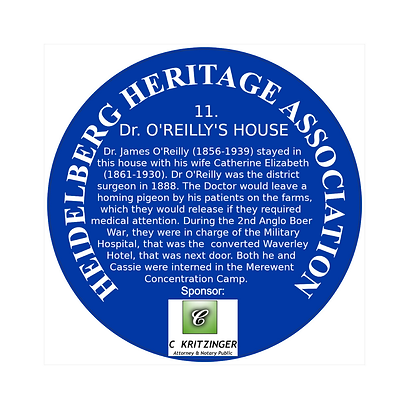
The domestic and medical history of the grand white mansion situated at the intersection of Pretorius and Ueckermann Streets. This profile details the life of Dr James O’Reilly, Heidelberg’s legendary District Surgeon, his close friendship with Paul Kruger, and his innovative use of medical courier pigeons.

#Hoër Volkskool Heidelberg
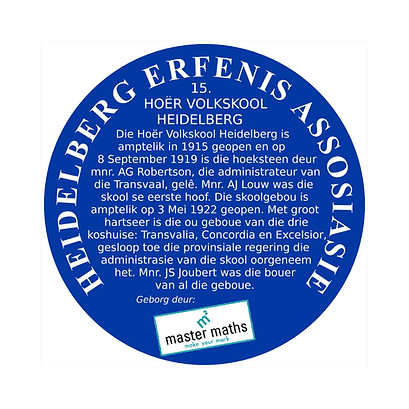
The history of Hoër Volkskool Heidelberg, the iconic secondary academic institution established on Opvoedingsbult. This text maps its multi-decade academic development, its fierce commitment to Afrikaans mother-tongue instruction, and its deep connection to the town's pioneer sponsors.
#Goedehoop Koshuis
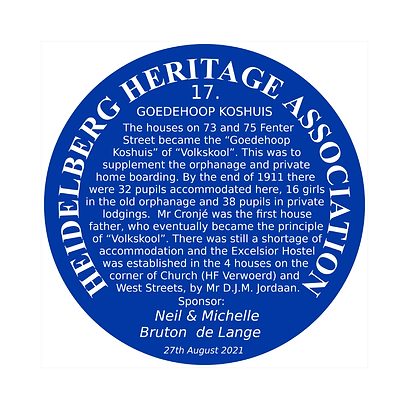
The history of the temporary Goede-Hoop-Koshuis student boarding facility, established in 1911 at 73 and 75 Fenter Street. This profile tracks its foundational house father, Mr Cronjé, the crowded student quarters, and the property's modern conversion into four semi-detached units.

#Heidelberg Railway Station
A detailed look at the structural history of the historic 1896 NZASM Railway Station building. Designed by chief architect V. van Lissa and built from red and white sandstone, this National Monument features ornate stepped gables and a unique commemorative stone laid in 1894.

#60 Van Der Westhuizen Street
The residential history of the historic property at 60 Van der Westhuizen Street. This chapter documents its late Victorian design elements, its multi-decade ownership transfers, and the sensitive modern structural restorations executed to protect its original inter-war character.

#Heidelberg Presbyterian Church
The foundational history of the Heidelberg Presbyterian Church, officially opened on 13 February 1906. This text documents the 1904 Land Department plot grant, the early Town Hall services led by Reverend Ross, and the chronological error carved into the front foundation stone.

#Dr Hale's Practice
The intriguing oral history surrounding "Dr Hale's House." This profile documents how successive property owners carefully preserved and passed down Dr Hale's original professional brass dental plaque, linking the home to mid-20th-century healthcare and the nearby A.G. Visser Hospital.

#Lutheran Church
The history of the Berlin Missionary Society and the German Lutheran Church on Spruyt Street, built in 1877. This chapter details the pioneering missionary work of Hermann Albin During, the destruction of his rural Woyenthin outpost, and the church's unique operational 100-year-old Pedal Organ.

#St Ninian's Anglican Church
The definitive history of St Ninian’s Anglican Church, dedicated on 8 November 1890. This chapter documents the 1882 foundation stone laid by Bishop Bousfield, the unique "double-ordered" stained-glass windows commissioned by Dr Nixon, and its extensive requisition as "The Soldiers' Church" in 1900.

#Nooitgedacht
The history of the Nooitgedacht smallholding estate, the private home of the versatile local businessman and successful recording artist Joe Kalil. This profile details his musical career performing as the lead vocalist "Johnny Collini", and his unique guitar-shaped outdoor swimming pool.

#Our Lady of Grace Catholic Church
The history of the Roman Catholic Mission and the Venetian Servite Friars in Heidelberg. This extensive chronicle details the 1933 construction of the priest's house by Swaziland brothers, the catastrophic 1936 wooden church fire, and the subsequent construction utilizing river sand and motor-oil plaster.

#Ou Herberg Hotel (Victorian Lodge)
The history of the Victorian Lodge at 67 HF Verwoerd Street, originally built around 1870 by town founder Heinrich Ueckermann as the Herberg Hotel. This text charts the conversion of its transit stables, its role during the 1886 gold rush, and its connection to the tragic confinement of Field Cornet Salmon van As.

#De Heidelberg School
The comprehensive history of early state and private education in Heidelberg. This text documents the tragic suicide of the 1868 Government School principal Mr Bouwer, the pioneering parallel language classes introduced under President Kruger in 1897, and the wild frontier era when lions roared near classrooms.

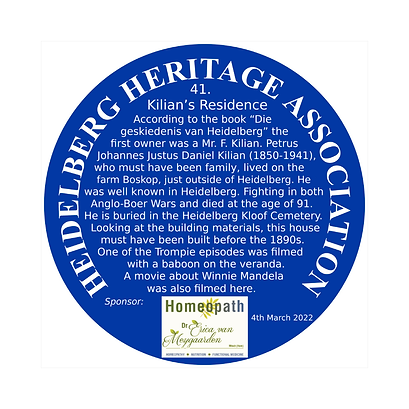
#Kilian's Residence
The residential narrative of the Kilian Estate, occupied since 2001 by the direct great-grandson of the celebrated Voortrekker descendant and Majuba war hero, Petrus Johannes Justus Daniel Kilian. This profile also highlights the property's later mid-century connection to the family of Senator Dönges.
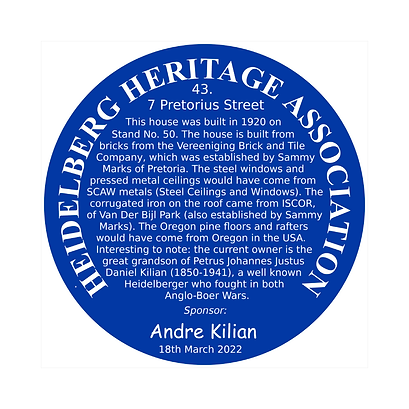
#7 Pretorius Street
The structural history of "Die Wye Stoep Huis" at 73 Pretorius Street, built circa 1890 over rough sandstone foundations with wide cavity walls. This text details its comprehensive 1920s re-modelling, the installation of pressed-metal ceilings, and its multi-decade municipal engineering logs.
#Mr Dettmann's House
The history of the historic Dettmann family commercial storefront precinct on Van der Westhuizen Street. This profile captures its magnificent interior craftsman woodwork, its role as a morning sweet shop for regional school children, and the 1988 establishment of the Van Dykshuis Guesthouse.

#Die Ou Meule
The history of "Die Ou Meule" commercial mill precinct on Schoeman Street, later converted into a prominent local bottle store. This chapter highlights the large historical town mural preserved inside the building, which is currently occupied by the Adendorff Machinery Mart and Emis Security.

#81 Merz Street
The property history of 81 Merz Street, originally registered to Mr van Staden before being acquired by James Pagan. This profile details Pagan's 1920 structural subdivision of the grounds, and the narrow sanitary lane implemented to provide municipal night-soil workers with rear access to the stables.

#85 Pretorius Street
The property narrative of 85 Pretorius Street, tracing its title deeds back to early gold fields claim allocations. This profile documents its subsequent architectural evolution, its mid-century structural expansions, and the private families who looked after the home's historic highveld character.

#83 Merz Street
The architectural history of 83 Merz Street, catalogued as Blue Plaque Number 53. This text details its early ownership by the Pagan family, the visible ruins of the original pioneer horse stables, and John Pagan's 1871 commercial trading alliance with William McLaren on Church Square.

#Mr Blyth's Residence
The history of the stately 1890s residence built at 2 Van der Westhuizen Street for accountant and legal agent George Kinnear Blyth. This profile documents his successful highveld practice, his founding patronage of the historic Heidelberg Club, and the property's modern 2022 Blue Plaque presentation.

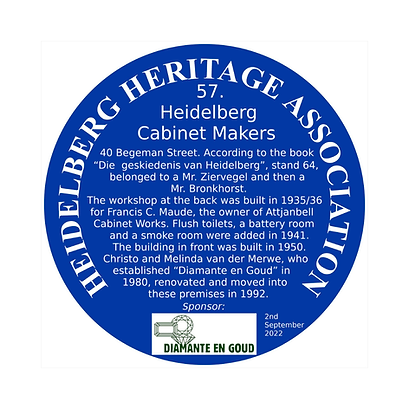
#Heidelberg Cabinet Makers
The manufacturing history of 40 Begeman Street, the commercial precinct that housed the Attjanbell Cabinet Works. This text documents Francis Maude's 1935 timber workshops, his 1941 battery and smoke room expansions, and Christo van der Merwe's 1992 renovation to establish his jewelry enterprise.
#The Lilienfeld Residence
The history of the Lilienfeld Residence at 65 Pretorius Street, built in 1899 for merchant J. Reichenberg. This extensive profile tracks its 1917 sale to George Lilienfeld, his family's purchase of the 83.5-carat Star of South Africa diamond, and its later occupancy by author Paul C. Venter.

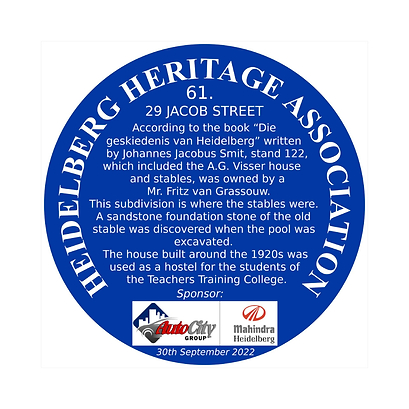
#29 Jacob Street
The history of 29 Jacobs Street, which functioned as part of the regional ZAR Mining Commissioner’s office complex during the gold rush. This text documents the 1920s conversion of the main house into a student boarding hostel for the Teachers' Training College, and the discovery of old stable foundations.
#2 Retief Street
The history of the Anderson Residence on Retief Street, constructed directly adjacent to the early 1905 Brickfield Native Settlement. This profile documents the discovery of the historic settlement's burial grounds along the Blesbok Spruit, and David Anderson's death at the Battle of Chrissiesmeer in 1901.

#9 Pretorius Street
The historical profile of 9 Pretorius Street, built in or prior to 1928 over a town block that originally belonged to General Piet Retief Viljoen. This text tracks its late 20th-century ownership changes, its preserved historic outspan horse stables, and the founding of the law firm Viljoen & Meek.

#5 Fenter Street
The property history of 5 Fenter Street, built circa 1890 and traditionally linked to romantic oral lore suggesting President Paul Kruger purchased it for his executive coachmen. This text documents a complete chronology of its deed transfers from 1866 up to its 2018 acquisition by the Le Roux family.

#Mr WWJJ Bezuidenhout's Town House
The history of 102 HF Verwoerd Street, the late 1800s townhouse of Member of Parliament Willem Bezuidenhout. This extensive text maps his founding patronage of Laer Volkskool, his close friendship with General Louis Botha, and the tragic 1950 fire at his Witpoort farm that destroyed the family's unwritten historical manuscripts.
#De Rust
The definitive history of "De Rust", a magnificent 22-room Victorian mansion constructed in 1906 by mining tycoon Frederik Jacobus Bezuidenhout (Second Generation). This text details its imported rosewood fireplaces, Italian mosaic tiles, its role as the birthplace of the National Party, and its private family cemetery.

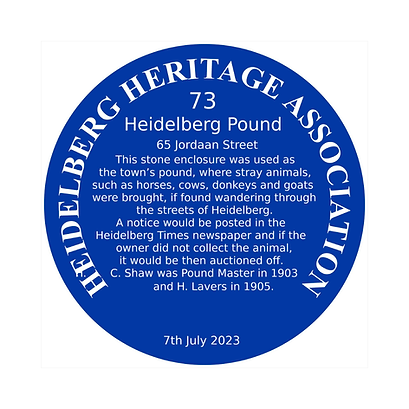
#Heidelberg Pound
The civic history of the Heidelberg Pound at 65 Jordaan Street. This profile documents the original natural stone enclosure utilized by municipal authorities to secure stray horses, cattle, and goats roaming the streets, alongside the early post-war administrative tenures of Pound Masters Shaw and Lavers.
#Heidelberg Kloof Cemetery
The definitive profile of the historic Heidelberg Kloof Cemetery, awarded Blue Plaque Number 75. This text maps the sacred burial sites of the town's foundational history makers, and details the grand post-war state funeral of the iconic guerrilla commander, Commandant-General Cornelius T. Spruyt.

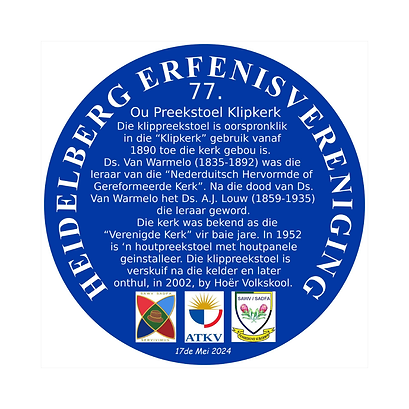
#Ou Preekstoel Klipkerk
The history of the historic 1890 Sandstone Pulpit, awarded Blue Plaque Number 77. This chapter details its original installation inside the Klipkerk under Reverend A.J. Louw, its mid-century removal to the church cellars, and its triumphant 2002 rescue and reconstruction inside the main hall of Hoër Volkskool.