
Your guide to Heidelberg Gauteng
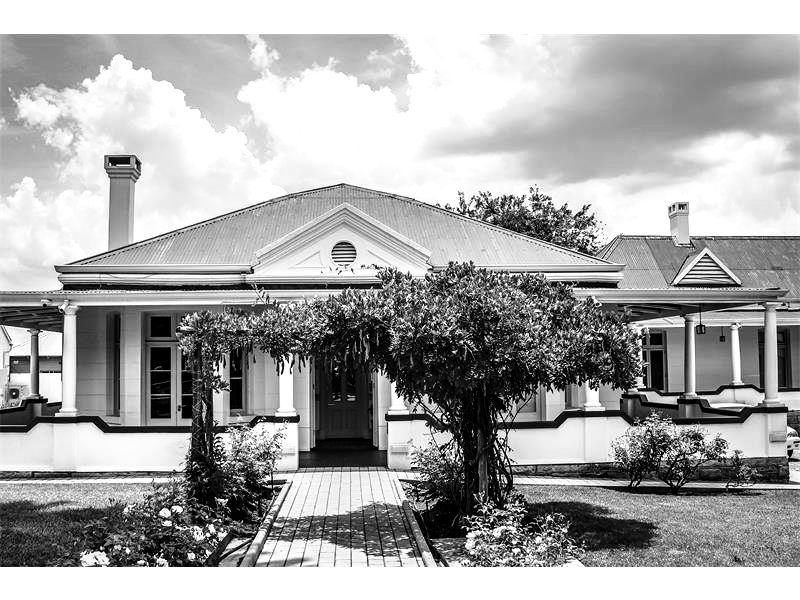
#Dr AG Visser House
Heritage Blue Plaque #Nr 68
DR AG VISSER HOUSE - Cnr of Van der Westhuizen and HF Verwoerd Streets

What is the story here?
Built in 1890. Where he practised as a doctor from 1916 to 1929. Well known poet, writing most of his poems in Heidelberg. In 1918 he was made honourable member of the “Afrikaanse Kultuur an Taalvereeniging” The house used to be a museum exhibiting his personal items as well as cultural and church items previously exhibited in the Klip Kerk’s basement. The house has since been vandalised and the exhibits stolen. Remgro, who donated the house to the local Municipailty, have taken back the house by an order of the court.
THE HISTORY OF THE A.G. VISSER HOUSE AND THE LIVING MUSEUM
THE BLUE PLAQUE RECOGNITION AND REMGRO RESTORATION (2022)
The supreme cultural, literary, and medical history of Heidelberg achieved formal preservation status on 2 December 2022. During an official civic ceremony hosted by the Heidelberg Heritage Association, local historian Mr Tony Burisch formally unveiled a prestigious Blue Heritage Plaque on the site of the historic A.G. Visser House. The plaque installation was fully funded through the private civic sponsorship of Nico and Louisa van Huyssteen - long-term, highly respected members of the community who have owned Hunters in Heidelberg and resided in the town for 25 years.
The extensive preservation and structural rescue of this iconic local landmark was executed and completed through a major joint venture between the organization Historical Homes of South Africa and the Remgro Group, directed by Dr Johann Rupert. The corporate funding from the Rupert family stemmed from a deep personal connection; the late industrialist Dr Anton Rupert had been a personal friend and medical patient of Dr Visser during the early 20th century, inspiring the family's modern mission to prevent the building from falling into decay.
The physical reconstruction work was executed by Carlos dos Santos Construction in close collaboration with the prominent heritage architect Charles van Breda. Nico van Huyssteen originally identified the critically dilapidated state of the property through the Heidelberg Chamber of Business, fiercely driving the multi-year project to completion. Van Huyssteen personally sourced and contracted the medical professionals to occupy the completed precinct, working alongside Pieter Kotzé of Historical Homes of South Africa to finalize long-term lease structures.
The extensive restoration process returned the entire building as close as humanly possible to its original 1890 architectural design. The executive planning committee successfully rejected alternative proposals to convert the landmark into a commercial boutique hotel or a kiosk coffee shop, choosing instead to protect its original purpose. The modern floor plan incorporates a beautifully curated boutique museum alongside active, operational consulting rooms for two medical doctors, a physiotherapist, and an occupational therapist. By bringing active healthcare practitioners back into the building, the A.G. Visser House has been masterfully preserved not as a stagnant monument, but as a living "House of Healing," exactly as it operated a century ago.
MINING ROOTS AND THE EARLY LIFE OF A.G. VISSER (1878 - 1901)
The historic primary residence was originally constructed in 1890 to serve as the official home and administrative headquarters for the resident ZAR Mining Commissioner of Heidelberg. The property was managed by highly prominent republican officials, including the decorated General Piet Retief Viljoen, who directed the district's gold rush claim allocations from the precinct.
The estate's historical trajectory transformed permanently in 1916 when it was acquired by Dr Andries Gerhardus Visser, a man destined to leave an indelible mark across the medical, political, and literary foundations of South Africa. Andries Gerhardus Visser was born on 1 March 1878 inside a temporary pioneer tent pitched beneath a pear tree on the farm Zaaifontein, situated in the Fraserburg district of the northern Cape Colony. He was the son of Andreas Gerhardus Visser and Martha Engela Elizabeth Visser (née Rossouw); his parents' graves remain preserved today on the farm Blaauwkrantz near Carnarvon in the Northern Cape.
In 1891, young Visser entered the historic Huguenot Memorial School (Hugenote-Gedenkskool) in Dal Josafat, Paarl. Here, he studied alongside two other youths who would rise to become foundational giants of the Afrikaans literary movement: J.D. du Toit (celebrated across South Africa under the pen name Totius) and D.F. Malherbe. Visser successfully passed his matriculation examinations at the Normal College in Cape Town in 1896, subsequently completing his formal teacher's training qualifications - a process then referred to simply as "the examination" (die eksamen). He entered the academic sector as a professional school teacher, later rising through the ranks to serve as a school principal in Carnarvon.
CONFINEMENT, EXILE, AND SCOTCH MEDICAL TRAINING (1901 - 1916)
During the height of the Second Anglo-Boer War, Visser voiced fierce, open support for the northern Boer Republics—the Zuid-Afrikaansche Republiek and the Orange Free State—in their armed struggle against British imperial rule. Because his home district within the Cape Colony was controlled by the British military command under strict martial law, the local garrison commander ordered Visser's immediate arrest. He was convicted of political insubordination and incarcerated inside the common gaol for an extended duration.
Upon his eventual release from prison, British authorities forced his immediate resignation from his state teaching post, barring him from local classrooms. Silenced by the colonial regime, Visser permanently abandoned the Cape Colony in September 1901, boarding a vessel bound for Scotland. He relocated to the Scottish capital and enrolled at the University of Edinburgh to pursue a new career path in medicine.
Visser successfully completed his medical studies and returned to South Africa as a fully qualified physician in 1906, re-establishing his professional identity by launching a private medical practice in Carnarvon until 1909. He subsequently relocated his practice to the Steytlerville region in the Eastern Cape, where he crossed paths with Laetitia Fransina "Lettie" Conradie, a talented 20-year-old local school teacher. The couple were officially married in 1913, and Visser spent seven years managing the healthcare needs of the Steytlerville community before permanently relocating his young family to Heidelberg in 1916.
TRAGEDY, TRIUMPH, AND THE SUIKERBOSRAND LITERARY HUB (1916 - 1929)
The doctor and his wife established their household inside the historic 1890 Mining Commissioner’s house, and the marriage produced three children: Andries Gerhardus Visser Junior (born 24 February 1915), Anna Francina Visser (later De Jongh, born 28 March 1918), and Willem Johannes Conradie Visser (born 16 January 1920). The household was devastated by a profound domestic tragedy on 3 February 1920, when Lettie passed away suddenly just over two weeks after giving birth to their youngest son. Deeply broken, Visser poured his grief into his writing, immortalising his late wife as the subject of his most celebrated, enduring poem titled "Laetitia".
In 1923, Visser was formally introduced to Martha Maria "Marie" de Villiers, a 23-year-old local woman, by her prominent grandfather, the celebrated philanthropist Japie "Helpmekaar" de Villiers. The courtship culminated in a grand community wedding on 4 July 1927, marking Visser's second marriage.
Throughout his years at the estate, the Visser House operated as the supreme cultural center of Heidelberg, with its large reception rooms functioning as an open salon where musicians performed, artists gathered, and high-level intellectual debates regarding the development of South African art and culture were hosted daily. Visser was a driving force behind local cultural preservation, serving as the active Executive Chairman of the Heidelberg Afrikaans Language and Culture Association (Heidelbergse Afrikaans-Taal en Kultuurvereniging). He also entered civic public service, securing election to serve as a prominent member of the Heidelberg Town Council in 1918.
Visser established a close personal friendship with the iconic author, journalist, and naturalist Eugène N. Marais, who frequently visited the home. Marais recognized Visser's natural linguistic brilliance and actively persuaded the doctor to systematically commit his verse to paper.
This creative partnership yielded exceptional literary results; Visser achieved national acclaim for his unique poetry, which was celebrated for its playful, deeply satirical wit that challenged conventional Afrikaner decorum and traditional social stiffness. He was twice awarded the prestigious Hertzog Prize (Hertzog-toekenning) - the supreme national accolade for Afrikaans literature. While he was not a member of the First Afrikaans Language Movement, literary historians universally revere his writings as the last notable, definitive works of the foundational generation of Afrikaans authors who lived and wrote prior to 1930.
DEATH AND HISTORIC LEGACY
Dr Andries Gerhardus Visser suffered a sudden, fatal heart attack inside his residence on 10 June 1929, passing away at the age of 51. The entire district went into deep mourning, and he was returned to the town center under a massive civic escort to be buried directly beside his first wife, Lettie, within the historic family plot at the Heidelberg Kloof Cemetery. A detailed bronze memorial bust of Dr Visser stands permanently mounted within the house's manicured front gardens to honor his legacy.
The historic property maintained its close ties to the town's prominent families through its subsequent 20th-century tenancies; prior to the Remgro restoration project, the national monument served as a private residence for numerous notable Heidelbergers, including the local historian Danie Steenkamp and Mr Faan Botha, a respected former Mayor of the town.
SOURCES AND CREDITS
-
Primary Historiography: Derived from the comprehensive heritage property feature article written by journalist Eugene Viljoen, published in the 7 December 2022 edition of the Heidelberg Heraut.
-
Restoration Documentation: Sourced from the structural blueprints, project logs, and executive placement registers compiled by Nico van Huyssteen, Pieter Kotzé, and the Historical Homes of South Africa association in partnership with the Remgro Group.
-
Biographical and Archival Tracking: Consolidated from the direct oral history records of Tony Burisch (Heidelberg Heritage Association) and the historical annals of the Heidelbergse Afrikaans-Taal en Kultuurvereniging.


