
Your guide to Heidelberg Gauteng
#Maternity Hospital
Heritage Blue Plaque #Nr 42
MATERNITY HOSPITAL - 22 Marais Street

What is the story here?
According to the book “Die Geskiedenis van Heidelberg 1838-1877” by Johannes Jacobus Smit the first owner was a Mr. Goetz. The house was built in 1894. It is assumed that there was a furrier on the property due to the fact that horse shoes were found when digging the foundations on the sub-division next door.
In 1938 the house was used as a maternity hospital under the care of a Sister Hutton. Mr. Edmond de la Harpe was born in the one room on the 1st September 1938.
THE HISTORY OF EDMOND DE LA HARPE AND VINTAGE HEIDELBERG
THE VAN DER WESTHUIZEN STREET ESTATE AND APPLIED VETERINARY LORE
The childhood memories of long-term local educator Mr Edmond de la Harpe provide a vibrant window into the mid-20th-century social landscape of Heidelberg. As a youth, Edmond resided with his parents inside a historic home that has since been completely demolished, with the site currently existing as a vacant stand nestled between Jacob and Strydom Streets along Van Der Westhuizen Street.
His father established a prominent profile within the municipal administration, working professionally as the official Dog Handler for the local Police force and concurrently serving in the prestigious chair as Worshipful Master of the localized Freemasons Lodge.
The family maintained a security pack of four highly trained Doberman Pinschers on the property, with two of the iconic dogs famously named Baas and Mona. Given his father's extensive professional expertise in canine handling and medical care, the residential estate functioned as an informal sanctuary, with local townspeople routinely bringing their severely sick dogs to the property for diagnosis and treatment.
An entertaining piece of family lore unfolded on the stand during his father's absence. A distressed resident arrived at the gates seeking urgent treatment for an ailing pet, prompting young Edmond to step into his father's role, diagnostic attributes, and explicitly recommend a specific medicinal compound for the owner to purchase from the local chemist storefront.
Upon his father's return, Edmond faced immediate domestic disciplinary trouble for dispensing unauthorized medical advice, but defused the anger by explaining in Afrikaans: "Maar Pa, ek het vir hulle gesê wat jy vir hulle sou gesê het!" (But Dad, I told them what you would have told them!). The remedy proved entirely successful, and the neighbor's dog was fully cured.
YOUTHFUL SCRUMPIES AND APARTHEID-ERA PLAYGROUNDS
During his childhood, Edmond regularly frequented the town's original rolling golf course, an extensive recreational layout that was subsequently subdivided and developed to establish the modern residential suburb of Overkruin. He routinely walked the greens playing matches alongside a close Black childhood friend who concurrently served as his golf caddy.
The youths also spent their leisure time roaming and exploring the rugged, open veld tracking immediately behind the grounds of the contemporary Heidelberg Army Gymnasium military base. Edmond recalled discovering an expansive, undocumented network of historic Black graves scattered across the ridges; he frequently landed in severe trouble with his mother for collecting and bringing salvaged historical burial artifacts back into the family home.
Edmond's educational journey was grounded in the town's premier independent institutions, attending classes at both Laer Volkskool and Hoër Volkskool. Like many local youths of his generation, he participated in the neighborhood tradition of illicitly "scrumping" or stealing ripe peaches from the orchards of the prominent Viljoen family estate situated at No. 1 Pretorius Street.
In a classic twist of residential irony, when Edmond grew up and established his own private home at No. 10 Louw Street, passing school children would routinely raid his meticulously maintained flower beds to steal his prized prize roses.
EDUCATIONAL LEADERSHIP AND DECORATED SPORTS COACHING
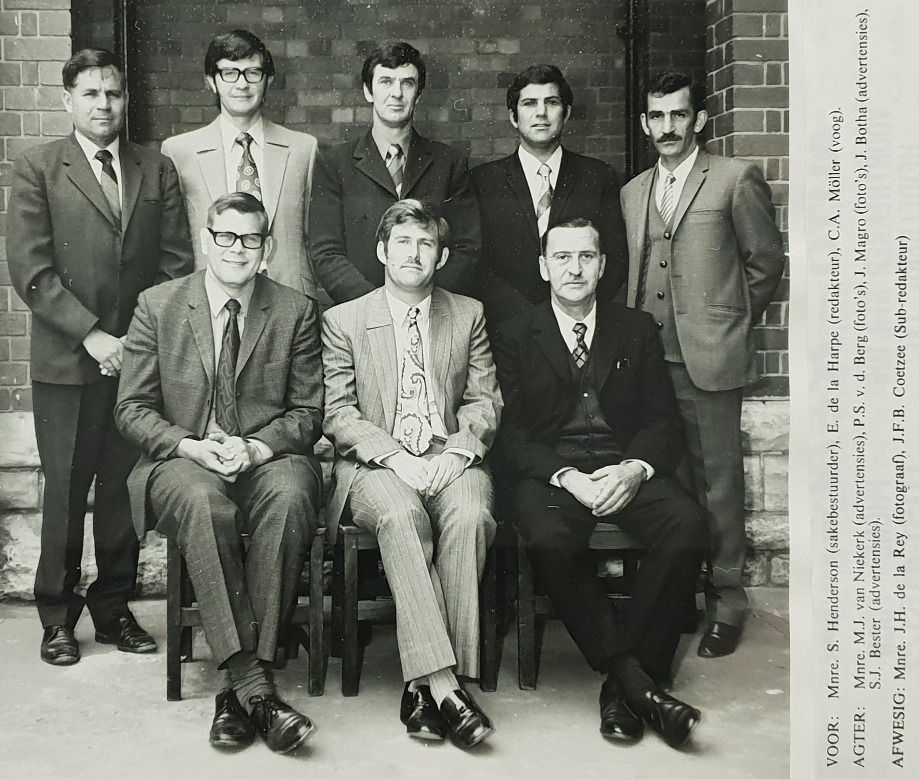
Following his matriculation from high school, Edmond committed his professional life to the field of education, enrolling as a full-time student at the historic Heidelberg Teachers' Training College. While completing his academic training on the campus, his sharp writing capabilities resulted in his appointment as the chief Editor responsible for compiling and publishing the college's prestigious 50-Year Anniversary Commemorative Book.
Upon his formal graduation from the training college, he successfully secured a permanent teaching post at his high school alma mater, serving continuously as the premier English Teacher at Hoër Volkskool for an exceptional 36-year career span and shaping generations of local scholars.
Edmond also achieved immense prominence across the regional sporting sector. An exceptionally agile athlete, de la Harpe was officially crowned the undisputed Heidelberg Squash Champion in 1922.
He systematically redirected his personal athletic prowess into community youth development, establishing a highly successful track record as a sports coach. His extensive, multi-decade contribution to regional youth athletics achieved absolute national validation in 1983, when he was formally awarded the prestigious State President's Award for Excellence in Sports Coaching.
COMMUNITY ECCLESIASTICAL SERVICE AND CONTEMPORARY RETIREMENT
Beyond his extensive scholastic and athletic achievements, Edmond dedicated himself heavily to the structural and spiritual governance of the town's primary landmark church. He entered public ecclesiastical service as a young man, successfully completing a historic tenure of more than 40 consecutive years as an active member of the ruling Dutch Reformed Klipkerk Church Council.
Today, at 83 years of age, Mr Edmond de la Harpe continues to reside locally within the scenic grounds of the Suikerbosrand Retirement Resort, preserving a lifetime of rich pioneering memories and historical narratives for the district.
SOURCES AND CREDITS
-
Primary Historiography: Derived from a comprehensive personal oral history interview conducted with Mr Edmond de la Harpe by local historian Mr Tony Burisch on behalf of the Heidelberg Heritage Association.
-
Archival Reference: Integrated with the residential tracking registries and Blue Plaque historical indexes curated by the Heidelberg Heritage Association.


